
- Intro
- Engine Mounts
- Manual Transmission
- Automatic Transmission
- Wiring
- Oil pan
- Exhaust
- Cooling and Plumbing
- Hood clearance
- Parts Required
- Installation
Intro
Note: Feb. 2013 – This article has been heavily revised to correct some information and provide much additional information. If you have read our technical article before, please read it again.
We have completely changed our ‘kit’ offerings for this conversion. Kits have been broken into smaller sections to better accommodate individual customer needs, in an effort to keep the expense of this conversion as efficient as possible. Please see our recommend parts reference for more information.
-
- 3.4L (5VZ-FE) Conversion
-
- 3.4L (5VZ-FE) Conversion
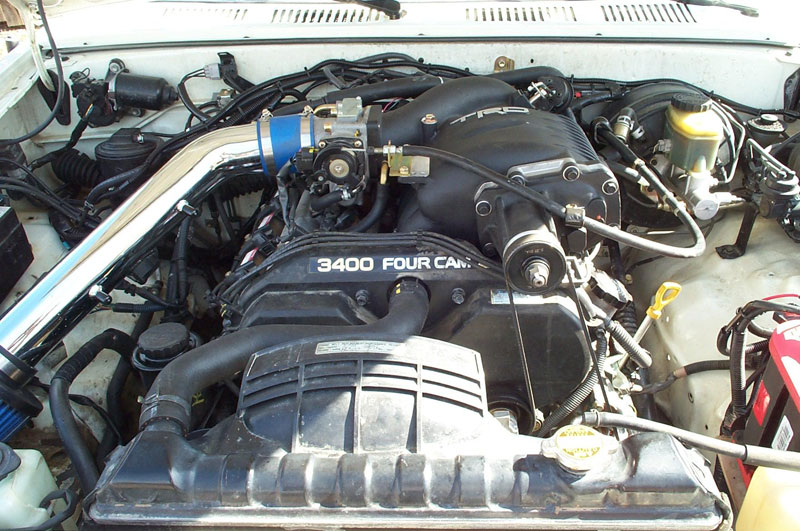
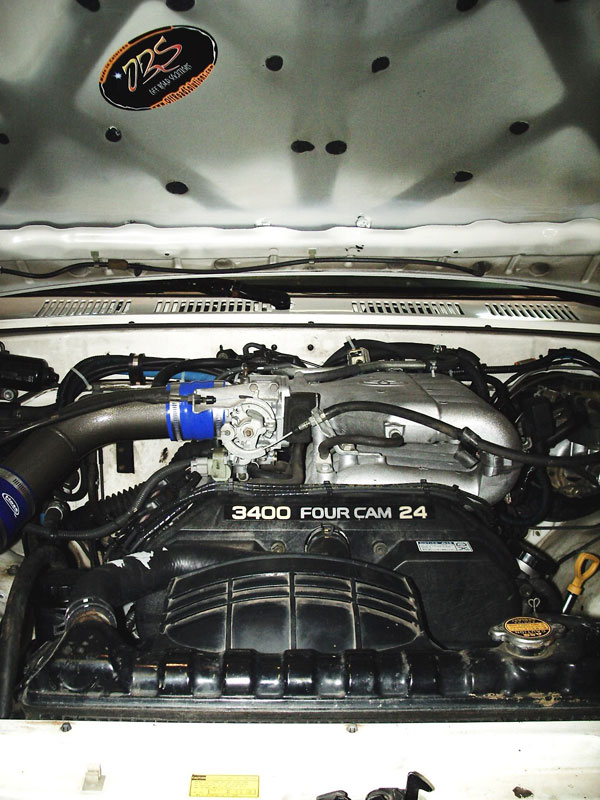
Off Road Solutions (ORS) has been performing the Toyota 3.4L (5VZ-FE) engine conversion since 2002, making us an innovator in this niche. We offer many conversion parts and technical aid related to this conversion. We have performed and assisted 3.4L swaps into a variety of vehicles; including older Toyota Trucks/4Runners, LandCruisers, rock crawlers, race vehicles, Jeeps and other unique applications. Our parts and expertise are derived from many years of performing and assisting customers with this conversion. This article contains information that should be helpful when considering and performing this conversion.
The 3.4L, 5VZ-FE was released in 1995 with the T100 & Tacoma trucks. It is the successor to the 3.0L, 3VZ-E. The engine code means that it is the 5th engine in the “VZ” family. “F” represents dual overhead camshafts in each engine head. The intake camshaft is driven by the timing belt, which turns the exhaust camshaft by way of a “scissor” gear. The “E” represents electronic fuel injection. This engine is found in 1995.5-2004 Tacoma, 1995-1998 T100, 1996-2002 4Runner and 2000-2004 Tundra models.
There are many advantages that lead people to use this engine in place of other conventional choices. The 3.4L uses better technology than most truck engines of its day. It is lightweight, yet powerful; producing 190HP at 4800 RPM and 220 lb-ft torque at 3600 RPM. It is equipped with a smooth Toyota multi-port fuel injection system, using a distributor-less ignition system and OBDII diagnostics. Its dual overhead camshaft design makes it efficient on fuel and offers great opportunity for power upgrades. This engine does well with forced induction modifications, such as the popular TRD Supercharger system. This engine also fits very well into a Toyota truck or 4Runner. Due to its size and components, the conversion can look “factory”, if performed properly. Don’t forget- one huge advantage is the “cool factor” of swapping in a late-model Toyota engine!
It is very convenient when all 3.4L donor parts come from the same vehicle. However, this is often not possible. When searching for donor parts from various sources, here are some general application differences that may be encountered:
- 1995-1996 Tacoma and T100 models use a 4-wire throttle position sensor (TPS), while all other models use a 3-wire TPS. Unfortunately the two TPS types have a different throttle body, so changing from one type to another requires changing the entire throttle body. If using a 4-wire TPS in a 3-wire system, removing the proper wire at the connector will still allow the use of the 4-wire TPS.
- 1998 and earlier air flow meters are larger and are part of the air intake tube. 1999 and newer air flow meters are much smaller mount to the side of the intake tube with 2 screws. Both share the same electrical connectors but will cause very poor drive-ability with the wrong engine harness. The cure to this problem is a simple re-pin at the connector. LINK
- 2001 and later models, 1999-2000 4Runner California, and 2000 Tacoma/Tundra California models use an ‘Air/Fuel Sensor’ in place of the upstream (pre-converter) oxygen sensor. While these sensors are identical in appearance, they are not compatible. These newer models will also require 2 catalytic converters, installed in series.
- 2001-2002 4Runner and 2002-2004 Tacoma and 2003-2004 Tundra models use an EVAP canister that is mounted under the vehicle, near the fuel tank. In this case (with the exception of strict emission testing), it is simpler to use an under-hood canister and parts from a 1996-2000 4Runner or 1997-2001 Tacoma.
- 2001-2002 4Runner and most 2003-2004 Tacoma/Tundra models were equipped with an Electronic Throttle Control System (ETCS), also known as ‘drive-by-wire’. This 5VZ system is all contained in the throttle body and still uses a traditional throttle cable. While this system also works well in a conversion, the engine harness and ECUs are different than other models. This will also have an effect on how Cruise Control can be utilized.
*It is important that the ECU and the wiring harness are compatible. There are many variations of these parts through the models and years, and they are not all interchangeable. If these parts cannot be located from the same vehicle, ORS can provide application recommendations.
Engine Mounts
The 3.4L 5VZ-FE is equipped with a similar mounting system to that of older Toyota Trucks/4Runners. For this reason it is a direct bolt-in for some applications.
With the use of block mount brackets and rubber insulators from a 3.0L 3VZ-E application, it will bolt straight into the frame mounts of a 3.0L vehicle. In some cases, this can also be done using the block mount brackets and rubber insulators from a Tacoma donor application. The preferred block mount bracket set is of cast steel construction and can normally be found on ‘90-’95 3VZ-E applications.
When performing this conversion in a 3.0L vehicle, the original transmission will also bolt straight to the engine in its original location.
When performing this conversion on applications originally equipped with a 22R/22R-E, the engine frame mounts will require modification or replacement, due to the dimensions and orientation of the 3.4L engine. Once the frame mounts have been modified or replaced, the 3.4L can be easily installed using 3VZ-FE block mount brackets and rubber insulators. ORS offers frame brackets and engine mount solutions for a variety of applications.
ORS also offers our 3.4L Performance Engine Mount Set for applications that require a heavy duty mounting system, such as racing or rock crawling. This mount set requires frame mount modification in every application. ORS offers frame brackets to accommodate our 3.4L Performance Engine Mounts in a variety of applications.
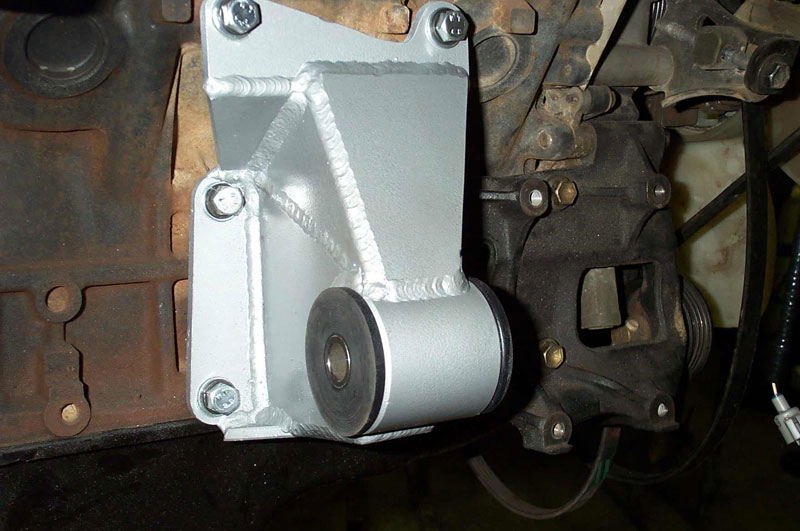
3.4L Performance Engine Mount
Manual Transmission
There are 3 Toyota manual transmissions that will bolt-up to and work with the 3.4L 5VZ-FE.
The first is the R150 that is found in models with the 3.0L 3VZ-E. This transmission will bolt to the 3.4L using its own bell-housing. This 5-speed manual transmission is nearly identical to the unit placed behind a 5VZ-FE from the factory (also called the R150). The only note-able external difference between the older and newer R150 is the length of the input shaft, the depth of the bell housing, and the bolt pattern on the rear (4×4 models). The later (3.4L) version uses a longer input shaft and deeper bell housing. The newer version also uses a driver side output transfer case (except T100 models) with a different bolt pattern. This often means it is easier and more economical to use the older R150 from a 3.0L application.
The second manual transmission that can be used is the R151 manual transmission, found behind a 22R-TE (turbo). The 4×4 version is mated with a gear driven transfer case that is equipped with a beefy 23 spline input; one of the strongest transfer cases found in a Toyota, and a popular choice in the rock-crawling arena. The R151 also has a lower first gear ratio. This transmission will require the use of a bell-housing from a 3.0L R150 when used behind the 3.4L 5VZ-FE engine.
The third manual transmission that can be used is the R150 found behind the 3.4L 5VZ-FE engine, w/ its own bell-housing. In 4×4 models this transmission was mated to a LH drop transfer case. The only exception is the T100 version, which used a RH drop transfer case. The 3.4L R150 has a unique bolt pattern at the rear that will require the use of an after-market adapter to install a RH drop transfer case. This adapter will require the customization of a gear-driven Toyota transfer case, equipped w/ a 23 spline input shaft and a ‘top-shifting’ configuration. ORS offers this aftermarket adapter and the parts necessary to create this custom transfer case.
The flywheel from either the 3.0L or 3.4L engine can be used. In many cases, the 3.4L version is slightly larger, thus offering a little more strength. A pressure plate, disc and pilot bearing that match the flywheel application can be used. The release (throw-out) bearing needs to match the bellhousing that is being used; a 3.0L application for the old R150/R151, and a 3.4L application for the newer R150. ORS offers clutch kits and individual clutch parts for this conversion.
If using the 3.0L R150 in a 1984-1995 model originally equipped with a 22R/22R-E, the transmission crossmember from the R150 vehicle can be used to bolt the transmission into place without modifications. The drive-shafts from a matching model (wheelbase and 4WD configuration) can also be used to avoid costly modifications to the existing drive-shafts.
If you are using a manual transmission, we recommend using 3.4L donor parts from a manual transmission donor vehicle. This is largely due to a difference in electronics. The engine ECU (computer) and the engine wiring harness are different from manual (MT) to automatic (AT) applications. In an automatic application, the engine ECU is also used to operate the transmission. When an automatic ECU is used in a manual transmission application, there are many trouble codes triggered, due to the absence of the transmission sensor and solenoids. In addition to a ‘check engine’ light that never turns off, this may lightly alter the engine performance in some cases. To some people these issues are OK; in this case the AT stuff can be used and we can still provide parts for such a conversion.
In some situations we have found that a manual transmission donor vehicle can be difficult to locate. For this reason we have helped ‘convert’ many AT donor setups to work with an MT setup. With 1998 and later models this can be done by simply using an MT ECU from the models. With 1995-1997 models this will require the use of an MT ECU and engine harness combination.
Automatic Transmission
There are 2 automatic transmissions that will work with the 3.4L engine conversions.
The first is the A340, found behind the 3.0L 3VZ-E engine, used in Trucks/4Runners and T100s; 1988-1995. The 4×4 version of this transmission was equipped with a unique transfer case (Truck/4Runner models), using a computer-controlled shift solenoid for the low-range function. When using this transfer case in a 3.4L conversion, an additional control circuit must be added to the wiring for the operation of the L4 solenoid. ORS can accommodate this circuit in our conversion wiring harness.
The other obstacle when using the 3.0L A340 in this conversion is the input speed sensor. The sensor in this transmission functions differently than the sensor used in the 3.4L AT applications. While this can be driven, it results in an imperfect shift pattern and continuous trouble code. The exception to this problem is a T100 application, where the 3.4L transmission used the same sensor type as the 3.0L A340 transmission. For this reason, using a T100 donor application (or at least the ECU) will result in perfect shifting and no trouble codes when using the 3.0L A340.
In some cases, the use of a 3.4L neutral-safety switch due to connector shape may be required. Also, note that the 3.4L engine harness will require some connector modifications when using the 3.0L A340 transmission.
The second automatic transmission that can be used with the 3.4L engine conversion comes from a 3.4L 5VZ-FE application, and is also called the A340. This A340 is very similar to the older version, but contains small upgrades to the torque converter, planetary gearsets, and the forward clutch.
The transfer cases found behind the 3.4L A340 in 4×4 Tacoma/4Runner/Tundra models have a LH front drive output, all 1995 and earlier Toyota 4x4s use a RH front drive output. There are external differences between the new and old A340 that prevent the use of an older transfer case. For this reason, an adapter is available that allows the installation of an earlier gear-driven transfer case to the 3.4L A340 auto transmission. This RH front output, gear-driven Toyota transfer case must be equipped w/ a 23 spline input shaft and a ‘top-shifting’ configuration. ORS offers this aftermarket adapter and the parts necessary to create this custom transfer case.
If using the 3.4L A340 from a Tacoma/4Runner/Tundra application in a 4×4 vehicle during this engine conversion, the use of a different transmission oil pan will also be required for front driveshaft clearance. The proper oil pan is from a T100 application. These transmission pan parts are best found used.
When using the 3.4L A340, the transmission cross-member and drive-shafts will likely require modification. The use of a 3.4L shifter assembly or modification to an existing 3.0L shifter will also be required.
When doing a 3.4L 5VZ-FE conversion with an automatic transmission, these parts must come from a 3.4L donor vehicle with an automatic transmission. This is largely because the engine harness and ECU contain much of the control circuit for the transmission.
Wiring
The wiring can be one of the more complicated parts of this conversion. The 5VZ-FE (3.4L) fuel injection system is different from that of older Toyotas. This means the 5VZ electronics will have to be in installed in the recipient vehicle, in order to make this engine swap possible.
There are 3 primary parts of the OEM 5VZ-FE fuel injection circuit. The first is the engine wiring harness. This is the harness that is primarily attached to the engine. This is sometimes called the injector harness. This harness connects many of the engine components such as the fuel injectors, ignition coils, air flow meter, etc. to the engine computer and the body harness.
The second part is the Engine Control Unit, or ECU. This is also called the Engine Control Module, or ECM. Sometimes it is just called the engine computer. This is the heart of the fuel injection system. This maze of solid state circuitry uses various input signals and outputs to control the engine.
The third part of the 5VZ-FE electronic fuel injection circuit is the body harness. This is sometimes called the “dash” harness or the “main” harness. It stretches across the inside of the dashboard and sometimes into the engine bay. This harness is the largest harness in the vehicle and carries the majority of the vehicle’s circuits. About 40% of the 5VZ-FE fuel injection wiring circuit is contained in this harness.
The engine wiring harness and ECU are easy to install in another vehicle when performing this swap, but the real challenge comes about when it’s time to take care of that last 40%. The ORS Conversion Harness is a great solution to this problem. Our conversion harness is designed to provide that last 40% of the 5VZ fuel injection wiring circuit. This harness connects directly to the 5VZ ECU and engine wiring harness. If the recipient vehicle is a Truck/4Runner w/ fuel injection, this harness also plugs directly into the older Toyota. The original wiring in the recipient vehicle is not altered or changed in order to accommodate the ORS wiring harness. The ORS Conversion Harness will also include the necessary emissions equipment wiring for your application. Additionally, this harness is designed to accommodate your OEM gauges (tachometer will require some additional work during the install), air conditioning, speed sensor, reverse lights, 4×4 system and 4×4 indicator lamp. The installation is almost entirely plug-in with only a small amount of splicing required.
The alternative is to re-wire your entire vehicle with a newer body wiring harness, or wire the engine circuit into your existing electrical system.
Another electrical item to consider is the battery. The 3.4L throttle body inlet faces the RH side, often requiring that the intake system (intake tube, air filter/box) is mounted on the RH side. This requires relocation of the battery. It is very common to re-locate the battery to the LH fender area, while others move the battery out of the engine bay entirely. ORS offers products that will help re-locate the battery to the LH side.
Oil Pan
Most 3.4L engines are equipped with an oil pan that is not compatible w/ most recipient vehicles. If the 3.4L donor application is a Tacoma, 4Runner, or Tundra, a different pan is needed to fit the suspension and steering in older Toyotas and other recipient vehicles. The oil sump on the above applications is in the front of the engine, where the steering and differential will interfere. The proper oil pan parts are from a 5VZ-FE T100 application. 4×4 T100 oil pan parts work w/ Truck/4Runner 4×4 IFS suspension applications, while 4×2 T100 oil pan parts work w/ Truck/4Runner 2WD and ‘solid axle’ (SAS) applications. Other oil pan-related parts, such as the oil sump and dipstick parts, are also required when converting the oil pan. The oil pan found on the 3.0L 3VZ-E engine can be used on the 3.4L 5VZ-FE during this conversion. However, the remaining oil pan conversion parts are still needed from a 5VZ-FE T100 application.
-
- ‘86-’95 4×4 ‘IFS’ Oil Pan Setup
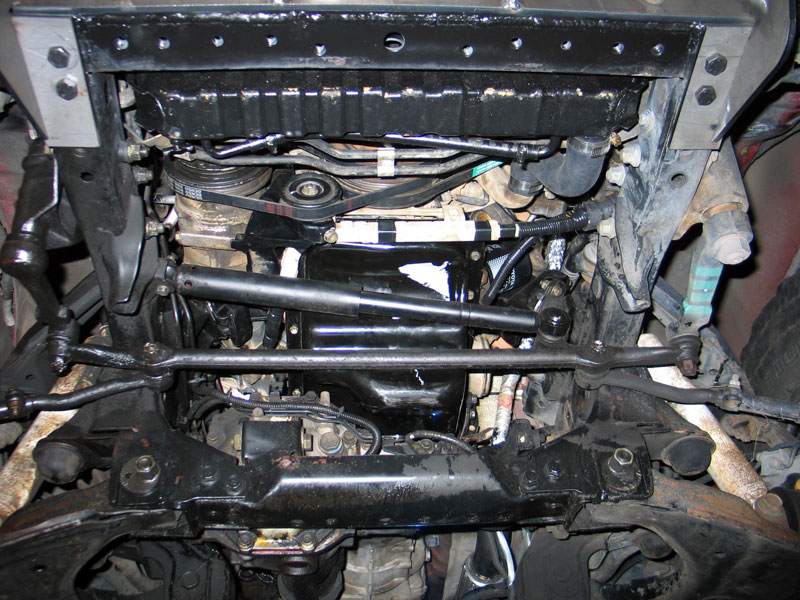
-
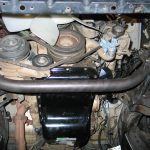
- Solid-Axle or 2WD Oil Pan Setup

Another concern is the oil dipstick placement. The dipstick on all Tacoma, 4Runner, and Tundra models is in the front of the engine, in the oil pump housing. During this conversion, the dipstick must be moved toward the rear of the engine. 1999 and earlier models have a machined hole with a removable plug, where the dipstick is installed. This plug can be found directly underneath the driver side engine mount, just above the oil pan (see illustration).
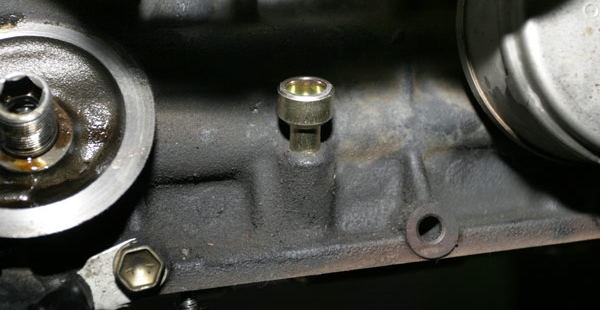
Machined hole with removable plug
2000 and later models do not have this provision. These models will require drilling a hole in this location.
Off Road Solutions offers a variety of oil pan kits, from ‘full’ equipped kits, to kits without a pan (when re-using the 3.0L oil pan), to kits for converting a T100 oil pan setup from 4×4 to 4×2. ORS also offers a ‘Dipstick Drill Guide’ to aid in the process of drilling a dip-stick-relocation hole on 2000 and later engines.
Exhaust
The OEM 3.4L exhaust uses a crossover pipe that collects the two manifolds and routes behind the engine, above the bell-housing. This pipe, however, exits on the RH side. This can pose a problem when installing this engine into an older Toyota, which has the exhaust system on the LH side. It is more difficult to route the exhaust down the RH side, due to brake and fuel lines, the transfer case, and the fuel tank.
There are a few common exhaust setups used during this conversion.
One very common exhaust setup uses the original exhaust manifolds from the 5VZ-FE, connected by a custom crossover pipe, designed for this conversion. ORS offers a custom crossover pipe, similar to the 3.4L OEM unit, but collects both banks on the LH side. This will allow a cleaner and easier exhaust system installation by “dumping” the exhaust on the proper side of an older Toyota, keeping the undercarriage free of any crossover exhaust pipes. With the ORS crossover pipe, a simple single-pipe exhaust system can be built to complete the exhaust system. If the original exhaust system is the proper diameter, it can be easily fabricated to connect to this crossover pipe.
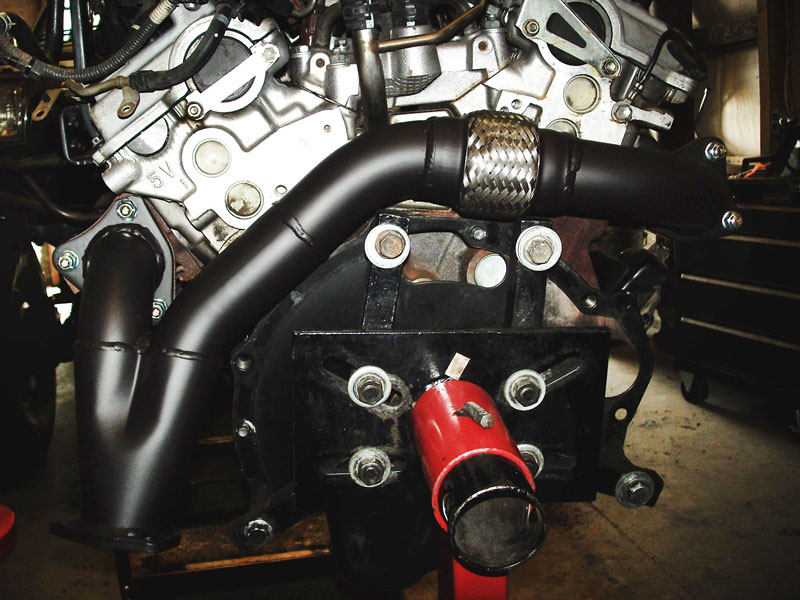
ORS 3.4L Exhaust Crossover Pipe
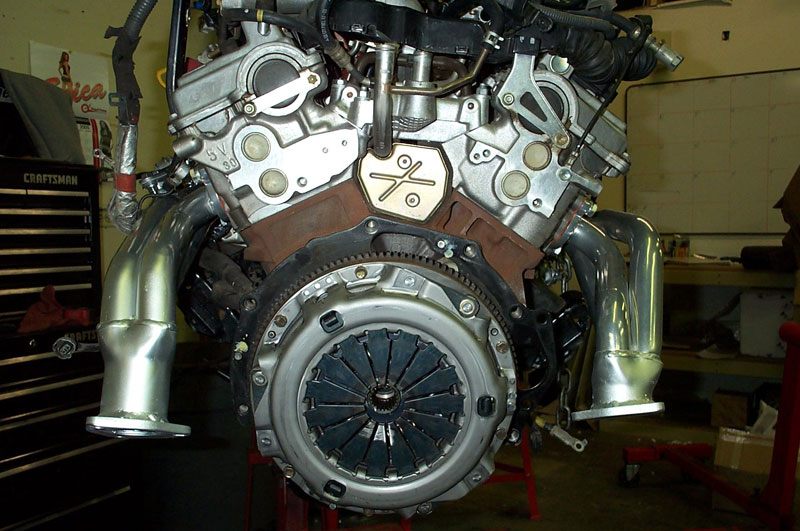
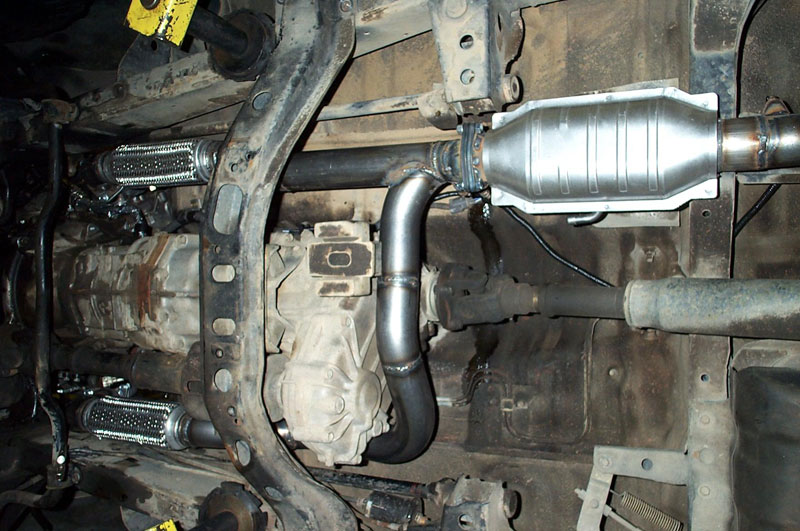
Another common exhaust setup is based around exhaust headers, when additional performance is desired. Aftermarket headers designed to collect under the vehicle are required. With this setup, exhaust is routed down both sides of the engine to a custom crossover pipe underneath the vehicle. Care must be taken when routing the exhaust down the RH side due to fuel lines, brake lines, the front drive shaft, and the fuel tank. The exhaust banks must collect before the first O2 sensor and catalytic converter. This method certainly costs more time and money, but will offer more airflow through the engine. If the donor engine does not have EGR, we recommend purchasing a header set specifically manufactured for non-EGR applications, as the EGR port often interferes with the steering shaft during this conversion.
-
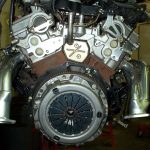
- Performance Exhaust Headers Installed
-
- Exhaust Banks Joined Under Vehicle
Another method is to use the original 3.4L exhaust crossover pipe and route the exhaust system on the RH side of the vehicle, normally crossing over to the LH side before reaching the fuel tank. In this case, care must be taken around the fuel and brake lines/hoses on this side of the vehicle.
We recommend researching the local regulations to ensure the exhaust modifications will be legal. If the donor vehicle had 2 catalytic converters (normally 2001 and later models), 2 converters are needed to satisfy the ECU’s catalytic monitor. If the donor vehicle only had 1 converter, 1 good replacement will suffice. 2 oxygen sensors are used on all 3.4L applications. The primary is placed before the catalytic converter(s), but after the banks collect. The other (secondary) is placed after the catalytic converter(s). We recommend using 2.25″ to 2.75″ diameter exhaust components, depending on your performance plans.
The primary O2 sensor (or Air/Fuel Meter in some applications) is essential to the operation of the engine. The ECU uses this sensor to monitor the oxygen content in the exhaust and continuously optimize the air/fuel ratio. This is important for both power output and fuel efficiency. The secondary O2 sensor is used by the ECU to determine the efficiency of the catalytic converter, by comparing it’s readings to that of the primary sensor. The absence of the secondary O2 sensor or catalytic converter will cause a ‘catalyst inefficiency’ trouble code, triggering the check engine light. In some cases, the ECU may also operate on a slightly altered fuel map, affecting engine performance.
Cooling and Plumbing
The cooling system is relatively simple in this engine conversion. The use of a 3.0L 3VZ-E radiator is recommended for older Truck/4Runner applications. This radiator will bolt directly into the existing radiator mounts and will cool this engine sufficiently, even in hot climates. The preferred radiator can be found in ‘89-‘95 V6 Truck and ‘90-’95 V6 4Runner applications. The upper radiator hose from a 3.4L application works well with this radiator. ORS offers a custom lower radiator hose that also works well with this radiator.
Heater hose installation is relatively simple. The heater hose layout found in older Truck/4Runner applications is relatively easy to duplicate when converting to the 3.4L 5VZ-FE. A combination of 3.4L and original hoses can sometimes be used. ORS also offers heater hoses that are selected to work well in this engine conversion.
Due to the nature of the belt pulley, it is best to use the power steering pump from the 3.4L application. 3.0L 3VZ-E application power steering high-pressure and low-pressure hoses can often be re-used during this conversion. ORS offers high and low pressure power steering hoses for replacement purposes or 22R/22R-E applications.
The 3.4L 5VZ-FE uses a high-pressure fuel system with a return line, like a 22R-E or 3VZ-E application. A 22R-E or 3VZ-E fuel pump is normally sufficient to operate the 3.4L engine. With the use of a supercharger, a fuel pump upgrade is recommended.
In 22R-E and 3VZ-E applications, the 3.4L engine can be connected to the existing high and low pressure fuel ports in the engine bay. The stock high pressure fuel hose on the 3.4L is normally not long enough to connect to the existing HP port. ORS offers a small extension or a full replacement high pressure fuel hose for these applications. 3.0L 3VZ-E applications can also utilize the existing fuel filter (located on the frame, under the vehicle). 22R-E applications will require the addition of a fuel filter, as the 22R-E fuel filter is mounted to the engine block. ORS offers a high pressure fuel hose with a built-in fuel filter for 22R-E applications.
For applications with no high pressure fuel system already in place (such as carbureted vehicles), ORS offers custom high-pressure fuel hose setups.
Hood Clearance
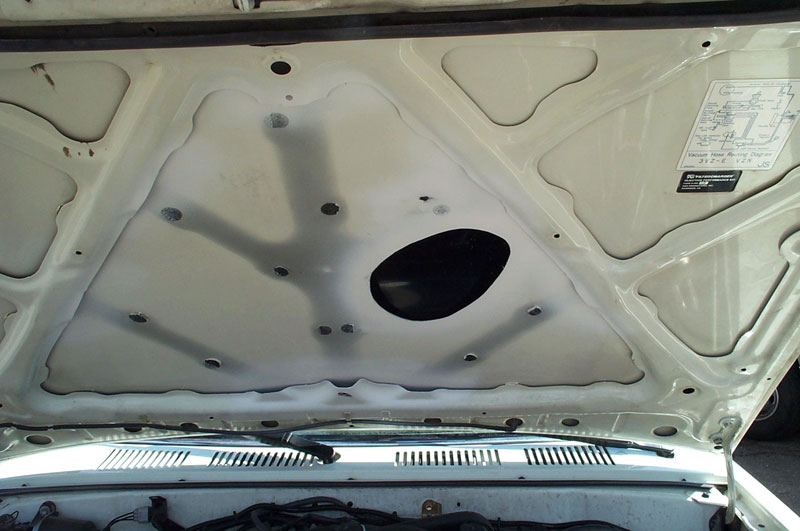
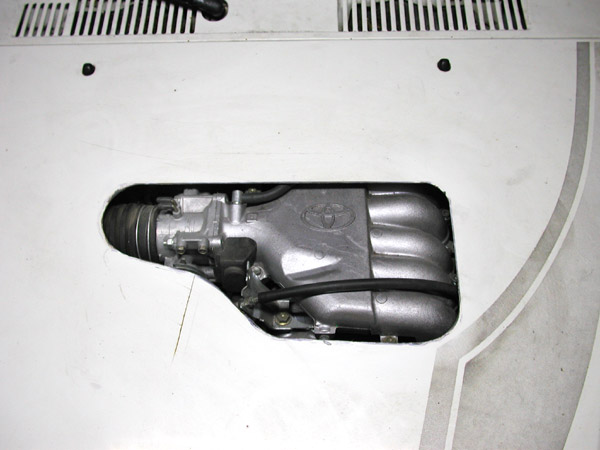
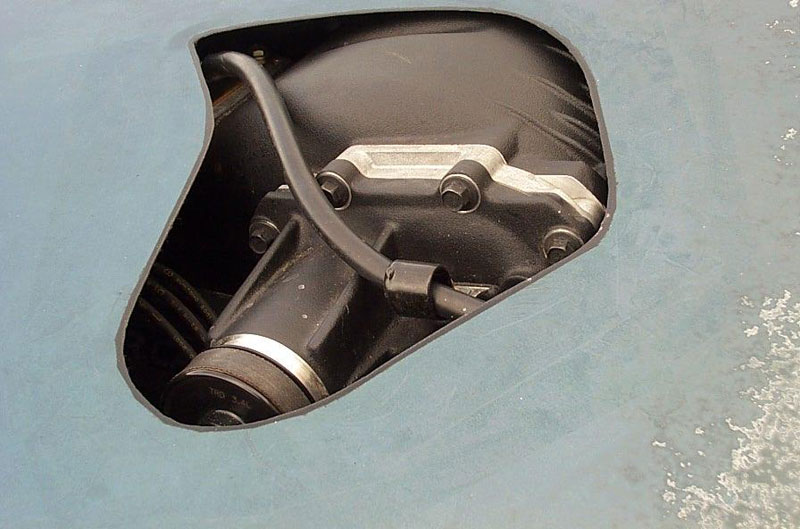
The 3.4L 5VZ-FE is physically too tall to fit under the hood of a 1979-1995 Truck/4Runner without modifications. The intake plenum is taller than that of the 3VZ-E, not allowing the assembly to fit between the front suspension and the hood. We have found that a small amount of hood trimming or a 2″ body lift will cure this problem.
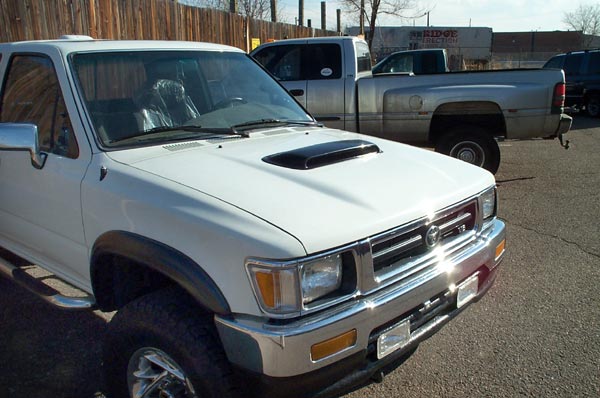
When cutting the hood, we have found that a small cosmetic hood scoop will cover the hole cleanly. The necessary clearance hole is a little larger on the ’84-’88 body style, and a TRD supercharger will require a larger clearance hole.
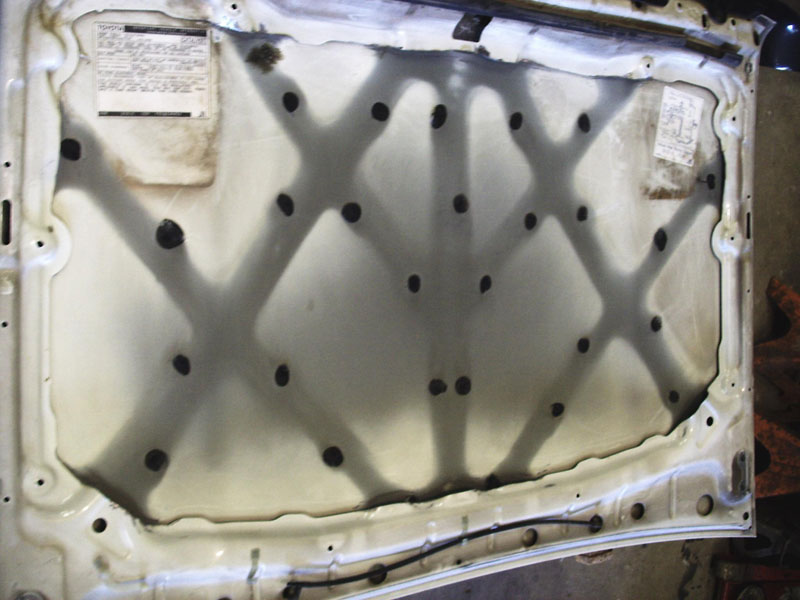
On some 1989-1995 trucks and 1990-1995 4Runners, we have also found that simply removing the bracing under the hood provides barely enough clearance, without cutting the hood panel itself. However, this is not always the case.
-
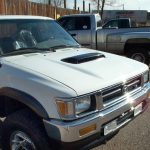
- Recommended Hood Scoop Installed
-
- Hood Cut Performed on ’89-’95 Body Style
-
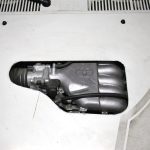
- Hood cut performed on ’84-’88 body style
-
- 1992 Hood With Bracing Removed
-
- Clearance Hole to Accommodate TRD Supercharger
Parts Required
When shopping for the parts in this conversion, there are a few groups of parts to consider.
- Donor Parts – The engine itself and the OEM parts associated with it. These parts are often found in a salvage yard. Another way to obtain the donor parts is to purchase a complete vehicle (normally wrecked) w/ a 3.4L 5VZ-FE engine.
- Conversion Parts – Parts that cannot be found on the donor or recipient vehicles. Some conversion parts are required to complete the swap, while some may not be required, but make the conversion easier or cleaner. ORS offers many conversion parts and kits to aid in the 3.4L engine conversion.
- Service/Repair Parts – When doing this conversion it is a good idea to replace simple service/repair parts that need attention. These parts may include spark plugs, drive belts, filters, timing belt, seals, etc. Many of these parts are available through ORS at competitive prices.
Donor Parts
This is a list of the OEM parts required from a 3.4L 5VZ-FE equipped vehicle. These are normally used parts. If parts are purchased through a salvage yard, we recommend purchasing this entire list as a ‘package’ deal from the same vehicle. Many of the parts listed below are normally on the engine.
- 5VZ-FE long-block; new, remanufactured, or used
- Both exhaust manifolds (unless using a header system)
- Intake manifold
- Intake plenum with throttle body
- All items on engine related to fuel injection such as injectors, fuel rail, VSV’s, sensors, throttle body, etc.
- Alternator and brackets
- Power steering pump and brackets
- A/C compressor and bracket
- Spark plugs
- Spark plug wire set
- Cylinder coil packs (3)
- Battery cable harness
- Engine (injector) wiring harness
- ECU (engine computer)
- Igniter assembly (flat, square shape, near intake box)
- Intake system- tubing, air box, air filter. If upgrading to an aftermarket intake system, only the air flow meter and hardware will be necessary.
- Air flow meter
- Evaporative canister (optional)
- Evaporative vapor pressure sensor
- Evaporative vapor pressure VSV
- Evaporative purge VSV
- Starter (3VZ-E starter can also be used)
- Flywheel with mounting hardware (unless using 3VZ-E flywheel) M/T
- Oxygen sensors (2), one on each end of catalytic converter
- OEM oxygen sensor exhaust ports (welded to pipe)
- All the OEM hardware you can get your hands on…
- Automatic transmission assembly w/ torque converter (optional) A/T **
- Shifter assembly (optional) A/T **
- Transmission cooler hard lines (optional) A/T **
- Transmission lower inspection cover (optional) A/T **
- Drive plate and mounting hardware (optional) A/T **
- Torque converter x drive plate mounting bolts (optional) A/T **
- Gear driven transfer case – 23 spline, top shifting configuration (4×4, optional) A/T **
**Items only needed for A/T applications where 3.4L A340 transmission is used
The following parts are required from a 3.0L 3VZ-E application:
- Radiator, preferably ‘89-’95 Truck, ’90-’95 4Runner
- Fan Shroud
- Radiator Fan (3.4L fan will also work)
- 3.0L fan clutch assembly (3.4L clutch will also work)
- Engine Mount Brackets, if using OEM style mounts, preferably ’91 and newer
- OEM hardware for transmission and engine mounting
- Oil pressure sending unit (if equipped with oil pressure gauge), 22R app. also OK
Conversion Parts, Service and Repair Parts
Click on the heading to see the application guide for that category.
[toggler title=”Wiring/Electrical”]
| Purpose | Application | Recommended Parts | Part Number | Notes |
|---|---|---|---|---|
| To wire engine control circuit | 85-’95 Truck/4Runner/T100 w/ 3VZ-E or 22R-E, Manual Transmission | Conversion Wiring Harness (M/T) | ORS-EC021 | |
| 85-’95 Truck/4Runner/T100 w/ 3VZ-E or 22R-E, Automatic Transmission | Conversion Wiring Harness(A/T) | ORS-EC023 | ||
| Other vehicles w/ at least a basic electrical system in place, Manual Transmission | Stand-alone Wiring Harness (M/T) | ORS-EC024 | ||
| Other vehicles w/ at least a basic electrical system in place, Automatic Transmission | Stand-alone Wiring Harness (A/T) | ORS-EC029 | ||
| To re-locate battery to LH side | 79-’95 Truck/4Runner | Battery Tray, LH Relocation, Full | ORS-EC030 | includes self-contained tie-down |
| Battery Tray, LH Relocation, Basic | ORS-EC040 | tie-down not provided | ||
| Battery Positive Wire Extension, LH Relocation | ORS-EC047 | safely extends fuse box positive lead | ||
| Battery cable replacement | 79-’95 Truck/4Runner | Battery Cable Harness | ORS-EC046 | only needed if OEM battery cable harness damaged/missing |
[/toggler]
[toggler title=”Exhaust”]
| Purpose | Application | Recommended Parts | Part Number | Notes |
|---|---|---|---|---|
| To collect exhaust banks on LH side for easy exhaust installation | ALL | Exhaust Crossover Pipe | ORS-EC070 | for use w/ OEM exh. Manifolds |
| Flex coupler, 2.5″ ID | EXH-001 | Highly recommended w/ ORS Crossover Pipe |
[/toggler]
[toggler title=”Engine Mounts”]
| Purpose | Application | Recommended Parts | Part Number | Notes |
|---|---|---|---|---|
| Simple engine install | 86-’95 4×4 Truck/4×4 & 4×2 4Runner, 22R & 22R-E | 4 Cylinder Frame Bracket Set | ORS-EC041 | OEM UCA mounts must exist |
| Engine Block Mount Set, OEM style | ORS-EC066 | used 3VZ set can be used, ’91-’95 | ||
| ALL | Engine Mount Insulators, OEM style | ORS-EC065 | used 3VZ set can be used | |
| Engine mount performance upgrade | ALL | ORS 3.4L Performance Engine Mounts | ORS-EC071 | |
| 79-’95 4×4 Truck/ 4×4 & 4×2 4Runner | Frame Bracket Set, for 3.4L Performance Mounts | ORS-EC07x |
[/toggler]
[toggler title=”Oil Pan”]
| Purpose | Application | Recommended Parts | Part Number | Notes |
|---|---|---|---|---|
| Oil pan suspension/steering clearance – non T100 donor only’ | 79-’95 Truck 4×2, ’79-85 Truck/4Runner 4×4, ’86-’95 Truck/4Runner w/ solid front axle conversion (SAS) | Complete Rear Sump Oil Pan Conversion Kit | ORS-EC088 | includes oil pan |
| Rear-sump Oil Pan Conversion Kit, without oil pan | ORS-EC090 | requires use of proper 3VZ oil pan | ||
| 86-’95 Truck 4×4, ’86-’95 4Runner – with OEM style independent front suspension (IFS) | Complete Rear Sump Oil Pan Conversion Kit | ORS-EC089 | includes oil pan | |
| Rear-sump Oil Pan Conversion Kit, without oil pan | ORS-EC091 | requires use of proper 3VZ oil pan | ||
| drilling oil dipstick relocation hole | 2000 and newer year-model donor engine | Dipstick Drill Guide Kit | ORS-EC093 | |
| Drill bit, U-size | ORS-EC096 | perfect size for dipstick relocation hole |
[/toggler]
[toggler title=”Cooling/Fuel/Power Steering”]
| Purpose | Application | Recommended Parts | Part Number | Notes |
|---|---|---|---|---|
| Fuel plumbing | 88-’95 3.0L 3VZ-E Truck/4Runner | High Pressure Fuel Hose, Full Hose | ORS-EC035 | replaces 3.4L OEM HP hose |
| High Pressure Fuel Hose, Extension | ORS-EC034 | requires use of 3.4L OEM HP hose | ||
| 85-’95 2.4L 22R-E Truck/4Runner | High Pressure Fuel Hose, w/ Filter | ORS-EC033 | replaces 3.4L OEM HP hose | |
| 79-’95 Truck/4Runner, 3VZ-E, 22R-E | Fuel Return Hose Kit | ORS-EC052 | bulk hose w/ clamps | |
| Fuel Line Union | TOY-90430-12028 | only needed if frame fuel line is Male | ||
| Power Steering Plumbing | 79-’95 Truck/4Runner | High Pressure Power Steering Hose, w/out rear-wheel ABS | ORS-EC031 | 3VZ-E version will also work |
| 90-’95 Truck/4Runner w/ rear-wheel ABS Braking System | High Pressure Power Steering Hose, with rear-wheel ABS | ORS-EC032 | 3VZ-E version will also work | |
| High Pressure Power Steering Replacement Hose, Rear ABS Actuator to Steering Gear | ORS-EC048 | replacement, only needed if original is defective/leaking | ||
| 79-’95 Truck/4Runner | Power Steering Return Hose Kit | ORS-EC053 | bulk hose w/ clamps | |
| Cooling system plumbing | 79-’95 Truck/4Runner w/out rear-heat | Complete Cooling Hose Kit, w/out rear heat | ORS-EC054 | radiator hoses, heater hoses, clamps |
| Heater Hose Kit, w/out rear heat | ORS-EC056 | heater hoses, clamps only | ||
| 4Runner w/ rear heat option | Complete Cooling Hose Kit, w/ rear heat | ORS-EC055 | radiator hoses, heater hoses, clamps | |
| Heater Hose Kit, w/ rear heat | ORS-EC057 | heater hoses, clamps only |
[/toggler]
[toggler title=”Clutch and Manual Transmission”]
| Purpose | Application | Recommended Parts | Part Number | Notes |
|---|---|---|---|---|
| Clutch Replacement | Using R150 (3VZ-E application) transmission, using R151 (22R-TE application) transmission | Full Replacement Clutch Kit | ORS-EC058 | 5VZ-FE flywheel required |
| Using R150 (5VZ-FE application) transmission | Full Replacement Clutch Kit | ORS-EC059 | 5VZ-FE flywheel required | |
| Clutch Hydraulic Fitting | 88-’95 3VZ-E Truck/4Runner | Clutch Hose and Bracket Set | ORS-EC060 | |
| Clutch Hose Bracket only | ORS-EC05x | requires use of original clutch hose |
[/toggler]
[toggler title=”Automatic Transmission”]
| Purpose | Application | Recommended Parts | Part Number | Notes |
|---|---|---|---|---|
| Trans. Oil pan to front driveshaft clearance | 79-’95 4×4 applications, when using A340 transmission from 5VZ-FE Tacoma/4Runner/Tundra | Transmission Oil Pan Conversion Kit | ORS-EC063 | Non-T100 donor applications only |
| Allow use of RH front output transfer case | 79-’95 4×4 applications, when using A340 transmission from 5VZ-FE Tacoma/4Runner/Tundra | Transmission to gear-drive transfer case adapter | MAR-34AT | Non-T100 donor applications only |
[/toggler]
[toggler title=”Service Parts and Installation Accessories”]
| Purpose | Application | Recommended Parts | Part Number | Notes |
|---|---|---|---|---|
| Replacement service parts where needed | ALL | Engine Service Parts Kit 3.4L 5VZ-FE | ORS-EC064 | |
| Supplies to aid in a clean installation | ALL | Engine Installation Accessory Kit | ORS-EC067 |
[/toggler]
Installation
Off Road Solutions offers full installation service for this engine conversion. We pride ourselves in performing a swap that looks original. We are very detail-oriented and take the time to be sure that the parts are properly installed, and the swap is fully tested. We do all that we can to ensure that problems due to installation will not occur down the road. We can also add performance modifications, such as performance headers and exhaust, a supercharger, and custom gauges. You will find some of our previous installations in the Shop Projects and Customer Rigs sections of this website. If you are interested in an installation, feel free to contact us.


